
Welcome:
Login
|
Sign Up
|
About CircleID
Follow:
|
|



|
||
|
||
As expected, VeriSign raised the price of domain names, effective in October. New prices wholesale prices (to the registrar) for .com domain names are going from $6.42 to $6.86, while .net will increase from $3.85 to $4.23. This news came a few days ago in a letter to registrars. (Hint to consumers: renew your domains now.)
VeriSign’s contract with ICANN lets them raise prices by 7% a year, and if the sun rises in the East, then VeriSign will raise prices to the maximum extent allowed. You’d think that as the number of domain names increases, prices would go down, right? Isn’t this the trend everywhere else in technology? You know, economies of scale and all that…
For instance, Moore’s law states that the number of transistors you can pack onto an integrated circuit will double every two years. There are lots of corollaries in other fields, where innovation and scale push either increased capabilities, or dropping prices. Here’s a short list where Moore’s Law is mimicked in other areas:
So, basically, many if not most of VeriSign’s registry costs have been falling at an exponential rate. Hard disk storage, computing performance, bandwidth, RAM storage—all central to registry operations. And yet the cost is going up. How is this justified?
At an ICANN session on deleted domain names in Cape Town in 2004, VeriSign complained about how much money they had to spend to handle all the non-registration activity (drop-catch, domain tasting, etc.). The registrars, almost as a chorus, volunteered to take over the registry and absorb all the costs. The registrars were well aware that the .com contract between ICANN and VeriSign was a virtual guarantee of what has been conservatively estimated at $3.4 billion in revenues for VeriSign over 8 years. Even supposing that this activity was the burden that VeriSign claims, ICANN’s better response would have been to get rid of the long-overdue recently-canceled [wait 5 seconds for annoying ad to disappear] much-abused 5-day grace period, which is responsible for much of the registry traffic.
VeriSign’s other justification for turning its plummeting costs into a price-hike is security. There is absolutely no doubt that the .com registry is pummeled by attacks from various malefactors, and that these attacks are not cheap to repel. It’s also true that VeriSign is one of the most reviled companies on the Internet; it shares the moniker “Evil Empire” only with Microsoft, and I don’t think it’s crazy to suggest that their security costs would go down if they didn’t do things to make people hate them. But why should they? The bitterness they engender only serves as justification for price hikes.
The .com contract with VeriSign, which allows for this price-hike, was not ICANN’s finest hour. If ICANN has any reason to exist, it is to prevent this kind of absurdity. ICANN’s original remit, after all, was to do two things: bring down the price of domains, and to create new top-level domains. On both fronts, performance has been less than stellar.
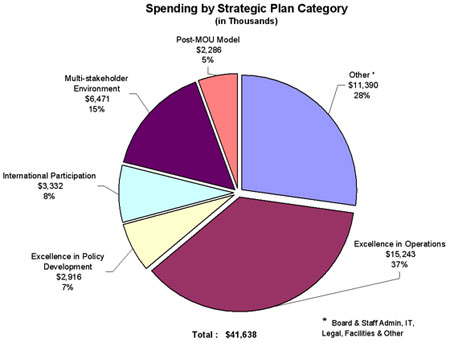
ICANN traded the community interest for some guaranteed money from VeriSign. It was a very simple trade in many ways, which allowed ICANN to bulk up to an annual $50 million budget. This is cleverly sliced up to appear to be diversified, but is upon closer examination really a lot of staff costs hidden under such categories as “Excellence in Policy Development” ($2.97M); “Excellence in Operations” ($15M) and so on.
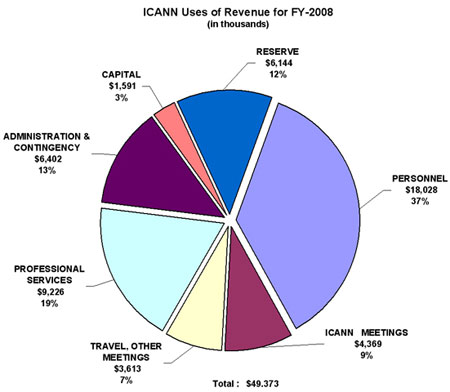
Overall, ICANN now spends 37% of its $50M on personnel (=staff); 19% on “professional services” (=outsourced staff); 13% on “administration and contingency” (=staff); 9% on ICANN meetings (mostly staff travel and lodging costs); and 7% on travel and other meetings (more staff travel costs). Of the paltry $1.59M spent on capital projects, $650K went to the L Root Server, $54K went to IANA for DNSSEC, while the much of the rest is for staff-related costs such as a new telephone system and new office furniture. This from an organization which is supposed to assure the smooth technical functioning of the Internet.
The charitable view of this Constantinian bargain is that because ICANN is now simply too big to abolish, Internet users everywhere should rejoice that VeriSign and other big companies and governments will never have unfettered sway. But the corrosive effects of the deal with VeriSign are still eating through the organization: in addition to the redistribution of wealth from Internet users to VeriSign, the .com contract once and for all got rid of the now-dated notion that ICANN consisted of its membership, and not its leaders and the ICANN staff. Today, I am not aware of a single person who is not being paid by ICANN who says “we” instead of “they” when referring to ICANN.
Still, now that we are done with the bibulous reign of Vint Cerf, we may cautiously hope for some improvement. For a possible preview, here is an lengthy interview with Peter Dengate-Thrush, the new Chairman.
I wish him luck. But unless things change, we are now living not with Moore’s law, which governs technology, but with many of Parkinson’s Laws, which govern unwieldy bureaucracies. C. Northcote Parkinson, who studied the British Army and Civil Service, noted that the number of employees in a bureaucracy rises 5-7% annually “irrespective of any variation in the amount of work (if any) to be done.”
Sponsored byWhoisXML API

Sponsored byRadix

Sponsored byIPv4.Global

Sponsored byCSC

Sponsored byVerisign

Sponsored byDNIB.com

Sponsored byVerisign


A World-Renowned Source for Internet Developments. Serving Since 2002.
Do ICANN meetings in as ugly and filthy cities as possible (this lot from Forbes mag would do for a start.. baku, azerbaijan, dhaka, bangladesh, bombay, india etc)
http://www.gadling.com/2008/03/16/worlds-25-dirtiest-cities/
See how fast travel gets minimized to the bare essentials.