
Welcome:
Login
|
Sign Up
|
About CircleID
Follow:
|
|
|



|
||
|
||
This visual depicts about half of the currently approved internationalized domain names (IDNs), positioned over their respective regions.
Notice the wide range of scripts over India and the wide range of Arabic domains. I left off the Latin country code equivalents (in, cn, th, sa, etc.) to illustrate what the Internet is going to look like (at a very high level) in the years ahead.
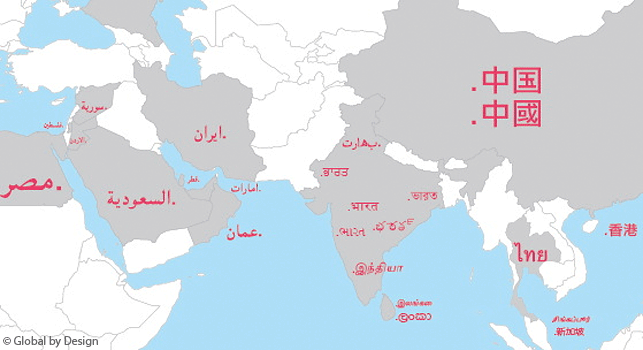
This next revolution is a linguistically local revolution. In terms of local content, it is already happening. Right now, more than half of the content on the Internet is not in English. Ten years from now, the percentage of English content could easily drop below 25%.
But there are a few technical obstacles that have so far made the Internet not as user friendly as it should be for people in the regions highlighted above. They’ve been forced to enter Latin-based URLs to get to where they want to go. Their email addresses are also Latin-based. This will all change over the next two decades.
For those of us who are fluent only in Latin-based languages, this next wave of growth is going to be interesting, if not a bit challenging. In a Latin-based URL environment, you can still easily navigate to and around non-Latin web sites and brands. For example, if I want to find Baidu in China, I can enter www.baidu.cn. For Yandex in Russia, it’s yandex.ru.
But flash forward a few years and these Latin URLs (though they’ll still exist) may no longer function as the front doors into these markets.
Try ??????.??. It currently redirects to Yandex.ru.
In a few years, I doubt this redirection will exist.
We’re getting close to a linguistically local Internet—from URL to email address. There are still significant technical obstacles to overcome. It will be exciting to see which companies take the lead in overcoming them—as these companies will be well positioned to be leaders in these emerging markets.
Sponsored byCSC

Sponsored byIPv4.Global

Sponsored byWhoisXML API
Sponsored byRadix

Sponsored byVerisign

Sponsored byDNIB.com

Sponsored byVerisign


A World-Renowned Source for Internet Developments. Serving Since 2002.
Hi John, love the map! very cool.
I disagree slightly on your predictions. I don’t think the navigation will be difficult for us that are used to the “Latin” URLs. We don’t necessarily have a need to go to the sites with the Russian/Chinese/Greek/etc URLs as content likely will be localized as well - and if we do need to then it’s simply nice that the Internet is still working globally so that you can click the Danish link I’m sending you, or that you find via search engine, and go to the site :)
The redirection in your example above might exist in a different way - taking you to the Russian portion of that same site, whereas the Latin URL takes you to the English portion. Users see these redirects many times now, for example based on location. If I type google.com in Denmark I am redirected to google.dk, which to some extent can be annoying.
But yeah, totally agree it is exciting to see what’s coming and how the new opportunities will be facilitated for the users.
Tina
I am totally agreed with John, beside of all above just think about new Geographic gTLDs which will express a location and it sounds localization to me. Thus IDN usage may explode all over the world.
for a small idea check out .?? registration reports.