
Welcome:
Login
|
Sign Up
|
About CircleID
Follow:
|
|


|
||
Iran’s political filtering during the recent 2009 presidential campaign and the role of the Internet in the post-election turmoil has brought a heightened level of attention to the country’s Internet filtering system. According to a status report just updated by the OpenNet Initiative, the Internet censorship system in Iran has become one of the most comprehensive and sophisticated in the world. Iran and China are the only countries that aggressively filter the Internet using their own technology. Iran’s aggressive filtering measures “have contributed to the implementation of a centralized filtering strategy and a reduced reliance on Western technologies,” says OpenNet.
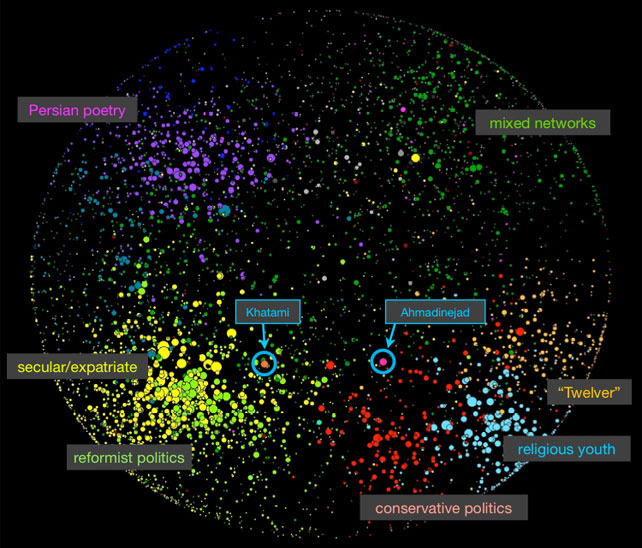 The map of the Iranian blogosphere produced by John Kelly and Bruce Etling for their paper, “Mapping Iran’s Online Public: Politics and Culture in the Persian Blogosphere.” —Source: Berkman Center
The growing popularity of the Internet has lead to increasing government scrutiny and control of online speech. The Iranian blogosphere has been “heralded as one of the largest and most active in the world,” says OpenNet—active blogs in the country estimated at approximately 60,000. In its analysis of Iran’s online public, Harvard’s Berkman Center for Internet and Society reports that contrary “to the conventional wisdom that Iranian bloggers are mainly young democrats critical of the regime, we found a wide range of opinions representing religious conservative points of view as well as secular and reform-minded ones, and topics ranging from politics and human rights to poetry, religion, and pop culture.”
Related Links:
OpenNet Initiative: Internet Filtering in Iran
Cracking Down on Digital Communication and Political Organizing in Iran
Keeping an Eye on Iran’s Post-Election Protests
Mapping Iran’s Online Public: Politics and Culture in the Persian Blogosphere (Interactive Map)
How Iran’s Internet works Alan Boyle, MSNBC, Jun.18.2009
Sponsored byVerisign

Sponsored byVerisign

Sponsored byRadix

Sponsored byWhoisXML API

Sponsored byCSC

Sponsored byDNIB.com

Sponsored byIPv4.Global


A World-Renowned Source for Internet Developments. Serving Since 2002.