
Welcome:
Login
|
Sign Up
|
About CircleID
Follow:
|
|



|
||
|
||
In a major win for the public interest, the Broadband Data Improvement Act passed the Senate (on September 26th) and the House (on September 29th). Due to amendments, it now goes back to the Senate for final approval (should be pro-forma) before it lands on George Bush’s desk.
With the United States falling further and further behind a host of other countries, the question on many people’s minds (including the folks over at Point-Topic who created this graphic) is, “Why is this happening?”
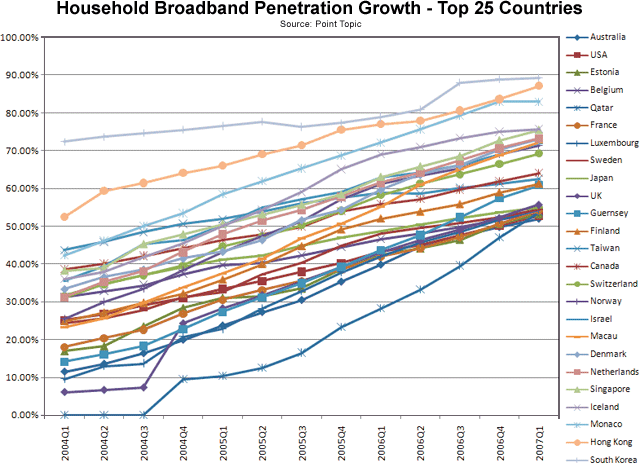
Yes, that’s the United States, chugging along ever closer to the bottom of the pack.
Senator Inouye and Congressman Markey have been pushing for the passage of this bill for quite some time—resurrecting the idea from congress to congress. The Act, with its explicit purpose “To improve the quality of Federal and State data regarding the availability and quality of broadband services and to promote the deployment of affordable broadband services to all parts of the Nation.” has drawn widespread opposition from telcos who’ve claimed that our current data collection efforts are “good enough.” Full text of the Act can be found here.
Among its mandates, the Broadband Data Improvement Act requires that:
Demographic Information for Unserved Areas- As part of the inquiry required by subsection (b), the Commission shall compile a list of geographical areas that are not served by any provider of advanced telecommunications capability (as defined by section 706(c)(1) of the Telecommunications Act of 1996 (47 U.S.C. 157nt note)) and to the extent that data from the Census Bureau is available, determine, for each such unserved area
(1) the population;
(2) the population density; and
(3) the average per capita income.
For those of us studying the digital divide, these data will provide much-needed information about the nature of underserved communities. Of course, they could also paint a damning picture of systematic, institutionalized redlining of poor and rural constituencies.
The Act also calls for an in-depth international comparison of broadband service levels, speeds, and pricing. 75 communities in 25 countries, matched “to the extent possible [by] population size, population density, topography, and demographic profile…comparable to the population size, population density, topography, and demographic profile of various communities within the United States” will be assessed.
Even more importantly, the Act requires a “Consumer Survey of Broadband Service Capability”—in other words, it requires collection of real-world information on what’s happening with broadband services in the United states. According to the Act:
For the purpose of evaluating, on a statistically significant basis, the national characteristics of the use of broadband service capability, the Commission shall conduct and make public periodic surveys of consumers in urban, suburban, and rural areas in the large business, small business, and residential consumer markets to determine
(A) the types of technology used to provide the broadband service capability to which consumers subscribe;
(B) the amounts consumers pay per month for such capability;
(C) the actual data transmission speeds of such capability;
(D) the types of applications and services consumers most frequently use in conjunction with such capability;
(E) for consumers who have declined to subscribe to broadband service capability, the reasons given by such consumers for declining such capability;
(F) other sources of broadband service capability which consumers regularly use or on which they rely; and
(G) any other information the Commission deems appropriate for such purpose.
Along with requirements to investigate how best to collect a host of different metrics and a mandate for states to likewise engage in broadband data collection efforts, the Broadband Data Improvement Act represents an important step forward in addressing the broadband market failure gripping the United States. Though the Act’s loopholes may yet allow for further obfuscation of critically important data, overall, this Act adds a great deal of momentum to efforts to increase digital inclusion and foster universal, affordable broadband access.
Sponsored byVerisign

Sponsored byCSC

Sponsored byDNIB.com

Sponsored byRadix

Sponsored byWhoisXML API

Sponsored byIPv4.Global

Sponsored byVerisign


A World-Renowned Source for Internet Developments. Serving Since 2002.