
Welcome:
Login
|
Sign Up
|
About CircleID
Follow:
|
|
|

 CTIA, the trade association for cellular companies, published a recent blog titled, "The Looming Spectrum Crisis". The blog quotes a study from Accenture that concludes that a lack of spectrum for 5G is reaching a point of crisis. The Accenture study says that cellular networks will be unable to meet nearly one-fourth of peak-period requests for connection as soon as 2027.
 Outside of China, very few governments would expect a saving in spectrum costs would mostly go to investment. Corporations have other priorities, including advertising and executive salaries. Stockholders come above everything at most companies. Rarely would even 1/3rd of the saving go to capital spending. The U.S. under Trump had a massive tax cut, worth literally billions to Verizon and AT&T. Verizon actually cut investment. AT&T's increase in capex was far lower than the tax saving.
Last week, I had the honor of moderating an engaging panel discussion at Mozilla on the need for community networks and the important role they can play in bridging the digital divide. The panel highlighted the success stories of some of the existing California-based initiatives that are actively working toward building solutions to get under-served communities online.
 In the 2014 Istanbul-Turkey IGF workshop on policies to promote broadband access in developing countries organised by Rui ZHONG of ISOC China, we realized that while technological solutions are advancing rapidly, policy and regulations remain a significant barrier to affordable internet especially in the developing world. According to a report by Alliance for Affordable Internet ( A4AI), the key to affordability is the policy and regulatory environment that shapes the different actors in the market.
 The FCC has long battled for a more efficient deployment of unused spectrum, endeavouring to adapt rules governing 'white space' TV spectrum (largely gifted to broadcasters years ago, and generally in the 700MHz band) to newly released spectrum (in the 600MHz band). This will considerably improve wireless broadband coverage where it is needed most... Certainly, in the US's disjointed broadband sector there are considerable challenges ahead...
 The Federal Communications Commission (FCC) in Washington has advanced its wireless health care agenda by adopting rules that will enable Medical Body Area Networks (MBANs), low-power wideband networks consisting of multiple body-worn sensors that transmit a variety of patient data to a control device. MBANs provide a cost effective way to monitor every patient in a healthcare institution, so clinicians can provide real-time and accurate data which allows them to intervene if necessary.
Canada has made impressive progress in mobile broadband deployment in recent months. This is partly due to operators needing to arrest falls in revenue from mobile voice services by buttressing their data capabilities, as also by the stimulus to the market introduced through the auction of Advanced Wireless Services spectrum in 2008. This auction overhauled the wireless market, introducing a number of smaller players which have added to the competitive mix as well as furthered the development of LTE.
I regularly bring this issue forward, similar to the discussion in relation to the structural separation of the fixed networks, which I began just over a decade ago. What we are seeing in the mobile industry is an infrastructure and a spectrum crunch. The amount of spectrum needed to satisfy people's demand from mobile phones, tablets and soon a range of other smart devices is limitless. Mobile carriers are scrambling for spectrum...
 Talk, conjecture and analysis have predicted a wireless spectrum crisis for years. The official word seems to project a culmination of dropped calls, slow loading of data, downright network access denials as impending by 2015. If so, then we should look at the current argument about how that additional spectrum can be disseminated to wireless carriers in a fair and balanced fashion.
40%, not 92%-120%. "Data consumption right now is growing 40% a year," John Stankey of AT&T told investors and his CEO Randall Stephenson confirmed on the investor call. That's far less than the 92% predicted by Cisco's VNI model or the FCC's 120% to 2012 and 90% to 2013 figure in the "spectrum crunch" analysis. AT&T is easily a third of the U.S. mobile Internet and growing market share; there's no reason to think the result will be very different when we have data from others.
 As a new study from Citi Investment Research & Analysis make clear, the US does not have a spectrum shortage. We've just allowed a relatively small number of carriers to control the spectrum. ... Perhaps if we had an effective "use it or lose it" policy in place, or a heavy tax on unused spectrum a more vibrant market for this spectrum would emerge.
In June, the net neutrality debate took an unexpected turn when the Netherlands leap-frogged the USA to became the first country to legislate for mobile net neutrality. Business models for fixed and mobile networks must shift toward volume charges. The net neutrality debate has been seen not having much relevance outside the USA because the plight of carriers there was aggravated by unlimited usage.
 The OECD held a "high-level" meeting in June 2011 that was intended to build upon the OECD Ministerial on The Future of the Internet Economy held in Seoul, Korea in June 2008. I was invited to attend this meeting as part of the delegation from the Internet Technical Advisory Committee (ITAC), and here I'd like to share my impressions of this meeting. This 2 day meeting, "The Internet Economy: Generating Innovation and Growth", had the objective of exploring a number of current issues in the public policy space...
New developments that have been announced by the FCC in the United States have rekindled the decade-old debate on the use of the so-called 'white spaces' in broadcast spectrum that are to be used for telecoms purposes. In September 2010, the FCC adopted a Second Memorandum Opinion and Order that updated the rules for unlicensed wireless devices that can operate in broadcast television spectrum at locations where that spectrum is unused by licensed services. This unused TV spectrum is commonly referred to as television 'white spaces'. The rules allow for the use of unlicensed TV devices in the unused spectrum to provide broadband data and other services for consumers and businesses.
The FCC's recent decision allowing license-exempt access to TV White Spaces, i.e. unused TV channels, is a small but very important step in spectrum policy. But, more important than the TV bands, is the policy approach and the fact that it was adopted in the face of extreme lobbying by well established vested interests.
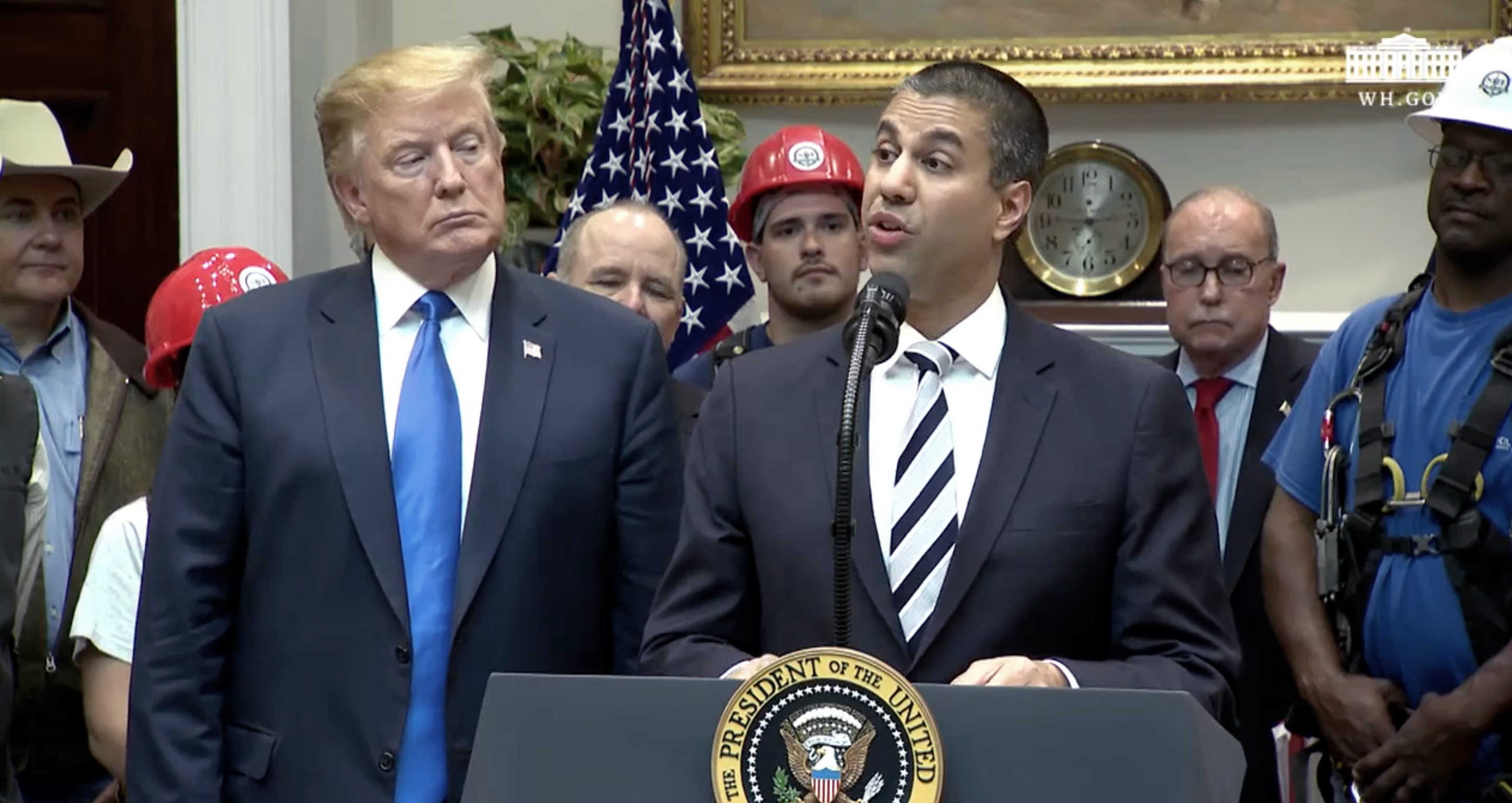 Trump Administration Announces Its Big 5G Push: Largest-Ever Spectrum Auction and a 20.4B Fund
 Broadband Now: Yes We Can… Stimulate the Economy, Says Industry Association
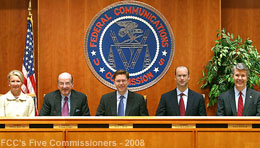 FCC Approves White Space for Broadband in Unanimous Vote
A World-Renowned Source for Internet Developments. Serving Since 2002.