
Welcome:
Login
|
Sign Up
|
About CircleID
Follow:
|
|

 With its perception still tinged by decade-old notions, DNSSEC in 2026 bears little resemblance to its troubled early years. Here's what the evidence says about its benefits, cost, and availability today.
 Publishing a DMARC record is only the beginning. New data show that many domains lack enforcement or reporting, exposing a gap between adopting email authentication and operating it effectively enough to detect problems and deter impersonation.
 Inactive cybersquatted domains may conceal active email infrastructure. MX records can corroborate bad faith in UDRP disputes when weighed with other evidence, helping panels address fraud risks before harm occurs without conflating capability with misconduct.
 Universal Acceptance Day 2026 marks progress toward a multilingual internet, as UNESCO and ICANN deepen cooperation. Yet unresolved implementation failures and weak registry stewardship still hinder truly inclusive digital access worldwide.
 Across Asia Pacific, millions are excluded from digital services because systems fail to recognise non Latin scripts, exposing how flawed design assumptions about internet users entrench inequality across the region in welfare, finance and education.
India's digital welfare systems, built without universal acceptance, have excluded millions from vaccines, wages and food, revealing how technical design choices can entrench inequality and reshape access to basic rights across rural regions today in India.
 Jay Fink had an interesting little business. If you lived in California, you could give him access to your email account; he'd look through the spam folder for spam that appeared to violate the state anti-spam law and give you a spreadsheet and a file of PDFs. You could then sue the spammers, and if you won, you'd give Fink part of the money as his fee.
CDA Section 230 has been called "The 26 Words that Created the Internet". While it is obvious how Sec 230 protects the World Wide Web, it is equally important for e-mail. A recent Pennsylvania court case emphasizes this point. Dr. Thomas, a professor at the University of Pennsylvania, forwarded an article about another professor Dr. Monge to an online e-mail discussion list. Dr. Monge claimed the article was defamatory and sued Dr. Thomas, the university, and many others.
 The DNS Abuse Institute recently published our sixth monthly report for our project to measure DNS Abuse: DNSAI Compass ('Compass'). Compass is an initiative of the DNS Abuse Institute to measure the use of the DNS for phishing and malware. The intention is to establish a credible source of metrics for addressing DNS Abuse. We hope this will enable focused conversations, and identify opportunities for improvement.
 Do you know someone who deserves recognition for helping build the Internet in their region or country? Or someone who made the Internet more secure through the work they've done? Or someone who made some major technical innovation that made the Internet faster or better?
 The steepening trajectory towards event-driven and real-time API architecture is imminent. This means incorporating event-based APIs into a technology strategy and leveraging existing API legacy systems that may have incurred a fair amount of technical debt, especially for historically progressive organizations.
 Network operators rely on guidance from IP address experts because not all IP addresses used on the Internet are the same. The "reputation" of email senders is especially important because some are malicious users of the system. But identifying "senders" based on their email addresses or the individual IP address of a user presents issues that are unnecessarily complex.
 Nowadays, with increasing digitalization and internet usage, email is a central communication tool. This holds true even despite the high popularity of instant messaging apps and social media. Email remains the favorite means of business communication worldwide, both in B2B and B2C. In 2019, 293.6 billion emails were sent and received. By 2025, this number will grow even more. It is predicted that we will send and receive 376.4 billion emails per day. In this scenario, implementing security features for email communications has become absolutely essential.
Happy Holidays. In September 2021, Apple rolled out iOS 15. For high volume email senders, Apple Mail now essentially tracks every email sent as an "open." Seemingly if you are a campaign engineer, high volume sender or ESP, this change can radically affect 25% - 45% of your email subscriber base, across both B2B, B2C or D2C. Inside your email analytics platform, you should see the specific percentage of Apple Mail users in your database, thus a significant rate of change ( delta) regarding inflated "open rates."
Look for this trio of email-related organizations MessageGears, Validity, Vidi-Emi, to become trailblazers in the RealTimeML Email landscape. This article will examine the nascent concept of utilizing RealTimeML to optimize for open rates and ultimately engagement rates by using a SendTime Email Optimization model. The model will infer RealTimeML predictions for optimal engagement rates, which provides enormous value throughout your current supply chain. Additionally, we will share ongoing time trials to serve the model efficiently.
 Microsoft Disrupts EvilTokens AI Cybercrime Service Linked to 12,000 Compromised Inboxes
 ICANN Sets Guidelines to Advance Universal Acceptance of Internationalized Domains and Email
 Government of India, MeitY Organizes 2-Day Event to Promote Universal Acceptance and Multilingual Internet
 Google Reports 18 Million Daily COVID-19 Related Malware, Phishing Emails Per Day
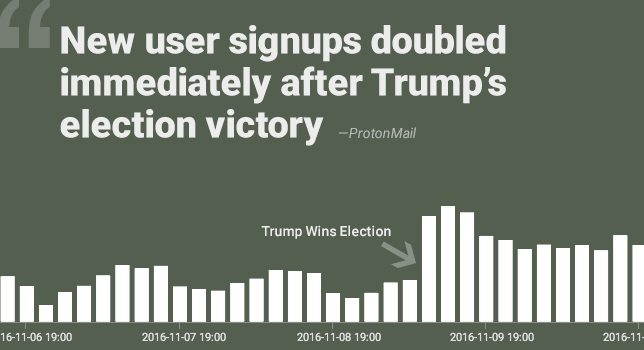 Encrypted Email Sign Ups Have Doubled Since Trump Victory, Says PortonMail
A World-Renowned Source for Internet Developments. Serving Since 2002.