
Welcome:
Login
|
Sign Up
|
About CircleID
Follow:
|
|
|

 The Internet was replaced by a dual system created in 2014: a fiber optic network called "Net2Cash". It has a speed of one hundred Petabits per second (equivalent to 100 million Gigabits per second or 100,000 million Megabits per second). We no longer talk about Megabytes or Gigabytes because that is old school. Nowadays a couple of Exabites store the content of all written by man, from books and newspapers to Sumerian clay tablets; from Inca quipus and Egyptian hieroglyphs to all homework made by kids registered in elementary school.
 The 85th meeting of the Internet Engineering Task Force (IETF) begins next week in Atlanta, Georgia, USA. Over 1000 engineers, maybe as many as 1400 or more, from all around the world will gather in various working groups to discuss and debate issues relating to the open standards that define the Internet's infrastructure.
 I was a little early. "By the end of President Obama's first term, there won't be any more copper landlines left in the country, I blogged just after Obama had been elected. Before that I'd prophesized the end of POTS (Plain Old Telephone Service) by 2010. Nevertheless, the end is nigh. And it's gonna be ugly without some planning.
And so it ends... Skype was always always a fun company to write about because they were always a bit of a rogue. The scrappy little startup that took on the megacorps of the telecom industry... and won in so many ways... look at their leading % of international calls... or the fact that per-minute call costs are now very clearly being commoditized down to zero...
 This is a followup to Wout de Natris' as usual excellent piece on the Enisa botnet report -- pointing out the current state of mobile malware and asking some questions I started off answering in a comment but it grew to a length where I thought it'd be better off in its own post. Going through previous iterations of Mikko's presentations on mobile malware is a fascinating exercise.
 We shouldn't settle for network neutrality. It's a poor substitute for what we had and much less than what we need. Let me explain. There are two topics to discuss. The first is "common carriage," a centuries old legal concept that applied to the US telecom industry throughout most of the 20th century. The second involves communications protocols. Both topics are complex, so I will cover only what's needed to understand why we shouldn't accept network neutrality and why, at a minimum, we should fight for enforcement of existing common carriage rules.
 Last week's news about Skype's planned IPO brings a renewed focus on what constitutes a service provider these days, and perhaps more importantly, what forms the basis for its valuation? We all know how the advent of IP has turned the economics of telephony on its head, and the drivers of value continue to shift from the physical world of network infrastructure to the virtual world of software, the Web and now the cloud.
 Canada's CRTC isn't as dumb as U.S. regulators who are considering ruling that the law doesn't apply where the telcos oppose it. (Title II deregulation) Canada just decided wireless needs to follow the rules. In turn, the CRTC intends to make sure the rules are reasonable. Rather than saying "never any rules," they instead try to write sensible ones.
In 2014, Cisco estimates Internet traffic growth in the U.S. will be less than 18%, far less than most previous estimates. Worldwide, they measure the current rate at 42% and expect that to fall to 30% in four years. Actual numbers at Cisco Visual Networking Index (VNI) is the definitive source on Internet traffic today because they have direct relationships with carriers from China Telecom to AT&T. Their future estimates are the most carefully done publicly available.
 For administrative convenience and not as required by law, the FCC likes to apply an either/or single regulatory classification to convergent operators. Having classified ISPs as information service providers, the Commission unsuccessfully sought to sanction Comcast's meddling with subscribers' peer-to-peer traffic. Now Chairman Genachowski wants to further narrow and nuance regulatory oversight without changing the organic information service classification.
 A brief report from the European Commission authored by Pedro Velasco Martins (an EU negotiator) on the most recent round of ACTA negotiations in Guadalajara, Mexico has leaked, providing new information on the substance of the talks, how countries are addressing the transparency concerns, and plans for future negotiations.
 Back in November 2008 a colleague of mine, Neil Watson (Head of Operations at Entanet International Ltd), published an article on Entanet's opinion blog about the government's proposed plans to centrally store records of all electronic communications throughout the UK. The Interception Modernisation Programme (IMP) will be the largest surveillance system ever created in the UK and calls for a 'live tap' to be placed on every electronic communication in Britain including telephone calls, emails and visited websites.
 This is a new development in the VoIP market. This is how one of my colleagues, Cullen Jennings explained it to me. Today we have two widely deployed global identifiers for reaching people. One is delegated address out of DNS and the other is phone numbers. So I consider an address like email: [email protected] or xmpp:[email protected] to roughly be out of the DNS namespace and phone number to be out of the E.164 name space. Phone numbers have lots of parts that are not cool, but they also have some cool parts...
Looking back at the year that just ended, here are the top ten most popular news, blogs, and industry news on CircleID in 2009 based on the overall readership of the posts. Congratulations to all the participants whose posts reached top readership in 2009 and best wishes to the entire community in 2010.
The New Zealand government has released a revamped three strikes proposal that incorporates full court hearings and the possibility of financial penalties. A prior proposal, which would have resulted in subscriber access being terminated without court oversight, was dropped earlier this year following public protest.
 Pirate Bay Co-Founder Goes Public with Alternate P2P-Based DNS Project
 Video: Engineers in Washington Discuss How Pending US Regulations Could Impact the Internet
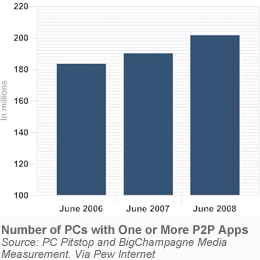 Pew Reports on the State of P2P, Music Online 10 Years After Napster
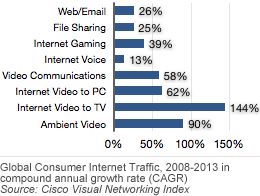 Annual Global IP Traffic Will Exceed Two-Third of a Zettabyte in 4 Years
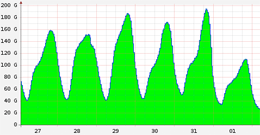 Sweden’s Internet Traffic Drops by a Third as New Anti-Piracy Law Kicks In
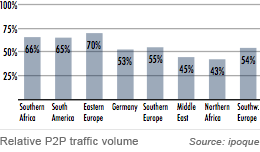 New Internet Study Finds Web and Streaming Higher Than P2P Traffic
 Google and Others Launch M-Lab, Allows Users Track ISP Performance
A World-Renowned Source for Internet Developments. Serving Since 2002.